

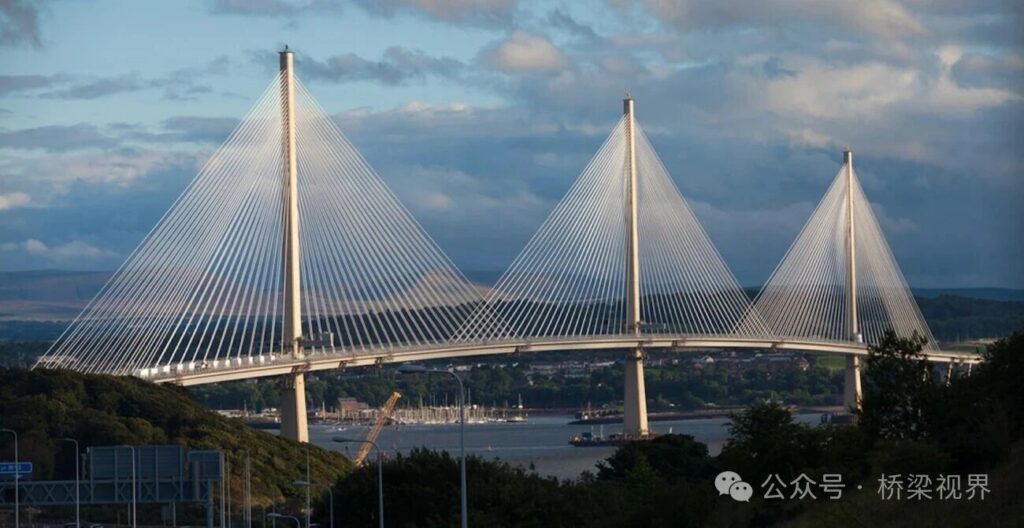
On Scotland’s east coast, the North Sea wind rarely rests. The three bridges spanning the Firth of Forth—the 1890 Forth Bridge (railway), the 1964 Forth Road Bridge, and the 2017 Queensferry Crossing—stand as a solidified “trilogy of time.” They chronicle a century of bridge engineering’s evolution, from riveted steel trusses to digital twins.
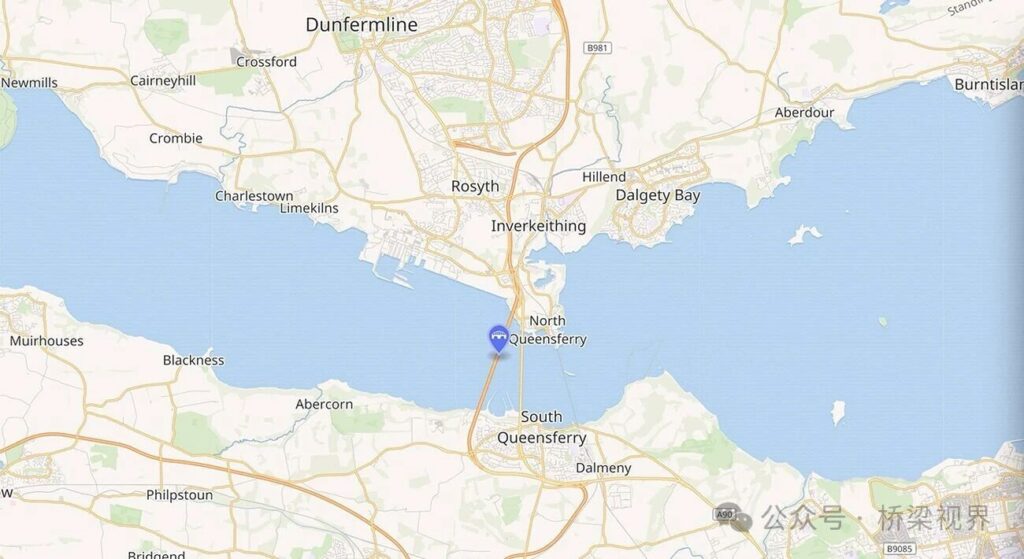
▲ A map showing the location of the Queensferry Crossing. The bridge spans the Firth of Forth in eastern Scotland, connecting South Queensferry with North Queensferry, just west of Edinburgh.
The new bridge’s name derives from the ancient towns on its shores: North and South Queensferry. According to legend, Scotland’s Queen Margaret established a ferry service here in the Middle Ages to aid pilgrims, hence the name “Queen’s Ferry.” Today, the Queensferry Crossing, which replaces the older road bridge, has become another 21st-century “royal project” for Scotland. It was personally inaugurated by Queen Elizabeth II, symbolizing a new era of intelligent and sustainable bridge construction in the UK.
Structural Aesthetics
The Queensferry Crossing has a total length of approximately 2.7 kilometers, with its main cable-stayed section spanning 2,090 meters. It was designed by a joint venture of Arup and Jacobs, and built by the Forth Crossing Bridge Constructors (FCBC) consortium. The bridge’s most defining feature is its “three-tower intersecting cable system,” a world first.
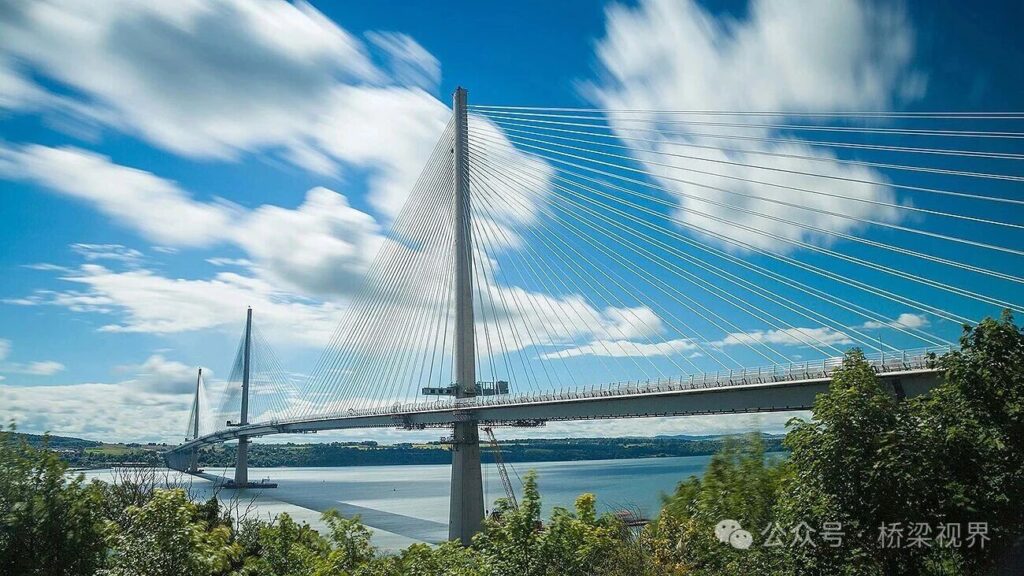
▲ The three-tower intersecting cable system of the Queensferry Crossing. The main span employs a unique multi-tower layout with intersecting cable groups, unifying structural performance and aesthetics.
Unlike traditional twin-tower cable-stayed bridges, the three-tower arrangement provides a more balanced transfer of forces between the deck’s two main spans. The stay cables intersect in the middle of the main spans, forming a fan-like web. Each cable not only supports vertical loads but also significantly enhances the deck’s lateral and torsional stiffness. According to Arup’s analysis, this intersecting cable system dramatically reduces wind-induced vibrations and improves the structure’s fatigue performance. The interwoven cables of the three towers are both a product of structural optimization and a unique visual rhythm—in the changing light, the cables play a harmony of strength and elegance, much like the strings of a harp.
Structural Response to Extreme Wind
The Firth of Forth, an estuary of the North Sea, is one of the UK’s most challenging maritime environments, constantly subjected to high winds and corrosive salt spray. To meet this challenge, the design team conducted hundreds of aerodynamic tests at the VTI wind tunnel in Denmark. They meticulously optimized the cross-sections of the towers and deck, resulting in a streamlined steel-concrete composite box girder design. Each 750-tonne segment of the box girder, measuring 39.5 meters wide, was prefabricated offshore and erected using the balanced cantilever method.
To ensure safety during high winds, 3-meter-high transparent wind barriers are installed along the deck, reducing wind speed at the vehicle level by approximately 40%. Viscous dampers and tuned mass dampers are installed at the tower tops and cable anchorages to suppress vortex-induced vibrations. These design features make the Queensferry Crossing one of the most wind-resistant sea-crossing bridges in Northern Europe, engineered for a 120-year design life.
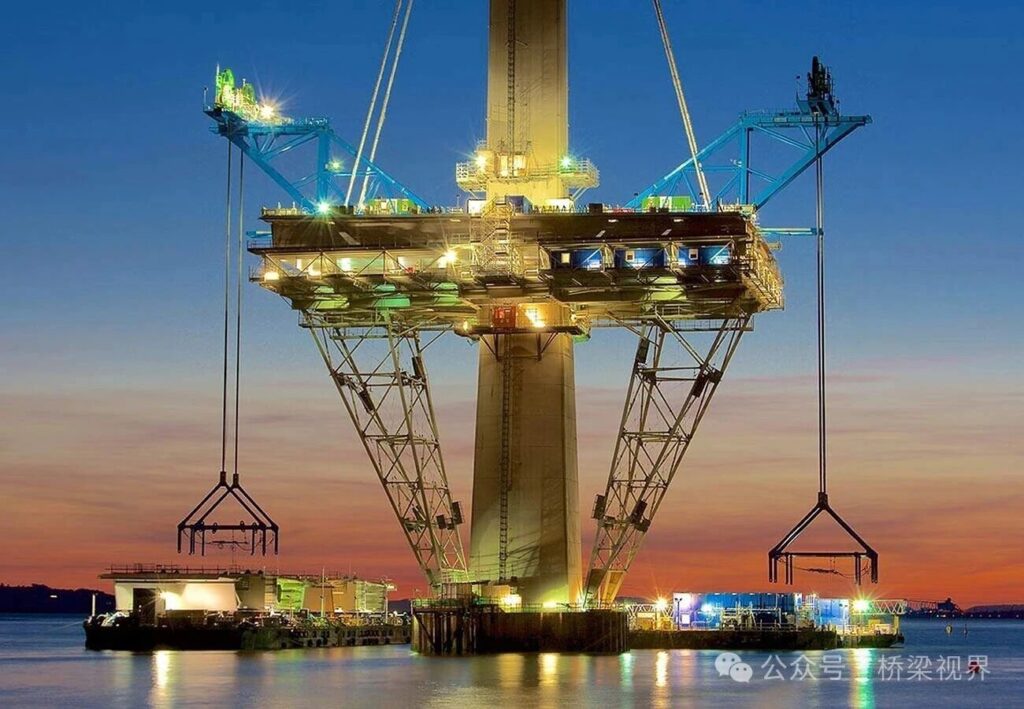
▲ The main span erection site of the Queensferry Crossing. Main girder units were installed offshore using the balanced cantilever method. Each 750-tonne, 39.5-meter-wide steel box girder was positioned by a floating crane and precisely aligned on either side of the pylon.
Construction was a constant battle against the elements. The three main tower foundations, 30-meter-diameter caissons, were sunk in an average water depth of 20 meters. Crews worked amidst tides and severe storms, adhering to strict tolerances: erection of each steel box girder was controlled to within ±10 millimeters, and the final positioning of the tower tops deviated by less than 25 millimeters. During the winter storms of 2015, high winds forced a 50-day work stoppage. Nevertheless, through precise project management and digital controls, the team completed the project on schedule—a rare feat in British bridge-building history.
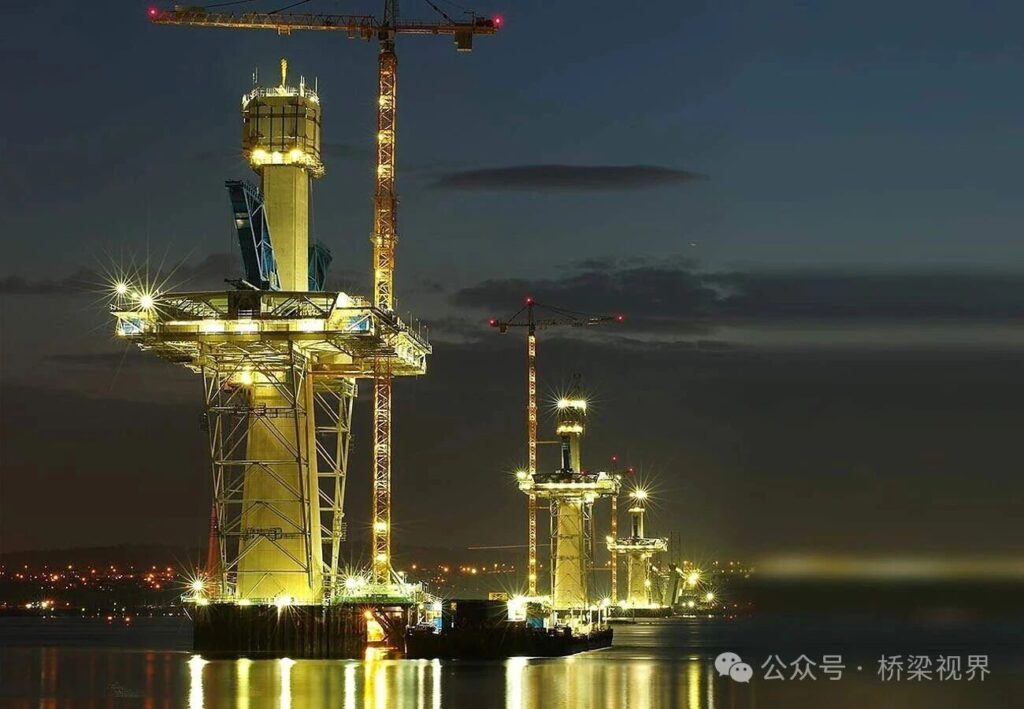
▲ A night view of the main tower construction at the Queensferry Crossing. Construction platforms and cranes, arrayed across the Firth of Forth, enabled synchronous work on all three towers, showcasing the high-precision construction management required for a major sea-crossing bridge in complex weather.
Material Innovation and Durability Design
The engineering team implemented systematic material optimizations to combat the harsh marine climate. The main towers are built from high-performance concrete incorporating microsilica and chloride-resistant admixtures to enhance crack and water penetration resistance. The 288 stay cables, with a total length stretching for tens of kilometers, consist of high-strength steel strands sheathed in durable HDPE (high-density polyethylene). The corrosion protection system features a three-layer combination of metal thermal spraying and an epoxy-polyurethane coating to withstand salt spray and freeze-thaw cycles.
Durability extends beyond materials to the bridge’s “ability to sense.” The Queensferry Crossing is outfitted with one of the UK’s most advanced structural health monitoring (SHM) systems. It features over 1,900 sensors that monitor cable forces, vibrations, temperature, humidity, and displacement in real-time. This data is aggregated via an IoT system and transmitted to Traffic Scotland, the national traffic management center, enabling predictive maintenance. As an Arup engineer noted, “This bridge was not just built; it was ‘connected’.”
A Dance of Three Bridges: A Cross-Century Genealogy
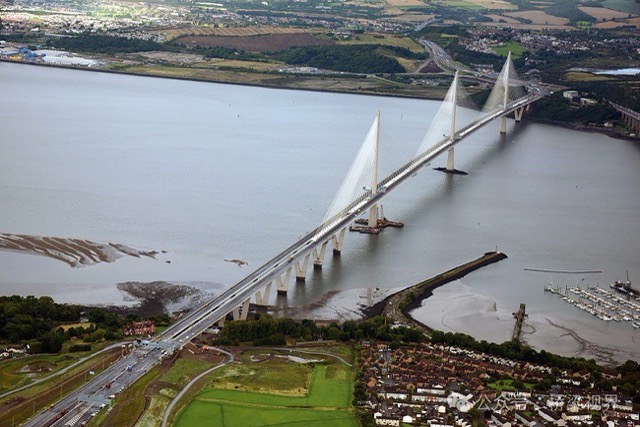
▲ An aerial panorama of the Queensferry Crossing. The bridge, spanning the Firth of Forth in eastern Scotland, features a three-tower intersecting cable system. At approximately 2.7 km long, it is one of the world’s longest multi-tower cable-stayed bridges.
The completion of the Queensferry Crossing not only resolved the fatigue cracking and poor wind-resistance issues of the 1964 Forth Road Bridge but also completely modernized the Firth of Forth transport network. The new bridge carries the main vehicular traffic, while the old bridge has been repurposed as a dedicated corridor for public transport, cyclists, and pedestrians. Alongside them, the iconic Forth Bridge continues to carry railway traffic across the centuries. The three bridges stand together, spanning three distinct eras of engineering—steel truss, suspension, and cable-stayed—symbolizing the continuous evolution of the field.
The project’s total cost was approximately £1.35 billion, coming in around £200 million under budget. Since opening, it has increased traffic efficiency by 25% and is projected to reduce annual economic losses from bridge closures by £10 million. Furthermore, the use of energy-saving materials and modular assembly methods resulted in a 25% reduction in carbon emissions, earning the project a “benchmark for European green infrastructure” rating from Ramboll.
Structural Rationality and Cultural Symbolism
British bridge engineering has always possessed a unique humanistic quality; its creations cross not only geography but also time and ideas. From Brunel’s 19th-century Clifton Suspension Bridge to the Forth Railway Bridge, these structures once symbolized the zenith of the Industrial Revolution: the power of technology, the order of reason, and the dialogue between humanity and nature. In British culture, bridges are never merely cold steel and stone; they are enduring symbols of both rationality and romanticism.
In this historical context, the Queensferry Crossing serves as the standard-bearer for the new century. Its three-tower form echoes the century-long bridge genealogy of the Firth of Forth, joining the railway bridge and the old road bridge to compose a trio of time: past, present, and future. Those three towers do more than bear loads; they stand as if on the axis of time itself, symbolizing continuity, order, and evolution.
On this bridge, structural logic and natural forces strike a new equilibrium. Engineers responded to the challenge of the wind with an intersecting three-tower cable system and realized the ideal of a “thinking bridge” through smart monitoring. It shows us that a contemporary bridge is no longer just a tool of connection, but a crystallization of technology and a cultural community.
Sources: Forth Bridges website, Arup Group (2023), Queensferry Crossing Digital Monitoring and Safety Assessment, Ramboll (2022), et al.